 Add to Chrome
 Add to Firefox
 Add to Edge
Grounded 3D-Aware Spatial Vision-Language Modeling
May 28, 2026
We present GR3D, a spatial vision language model equipped with three complementary grounding capabilities--explicit 2D grounding, implicit 2D grounding, and monocular 3D grounding--within a single framework. GR3D introduces an implicit grounding mechanism that identifies entity mentions during generation and inserts the corresponding region tokens into the text stream, allowing the model to reference visual evidence on the fly when producing spatial chain-of-thought responses. In parallel, a region-prompted monocular 3D grounding design predicts 3D bounding boxes in the camera view from grounded region queries, supported by intrinsic-aware normalization and dense geometric supervision. Together, these grounding capabilities enable GR3D to decompose complex spatial understanding problems into grounded 2D perception followed by 3D inference. GR3D achieves consistent improvements across grounded and non-grounded spatial benchmarks, demonstrating grounding as an effective inductive bias for strengthening spatial understanding in VLMs. These grounding capabilities collectively enhance general spatial understanding beyond the grounding task itself.

JetViT: Efficient High-Resolution Vision Transformer with Post-Training Attention Search
May 26, 2026We introduce JetViT, a novel family of hybrid-architecture Vision Transformer (ViT) models that match the accuracy of state-of-the-art full-attention vision foundation models while achieving substantially higher inference efficiency on high-resolution images. At the core of our approach is Post-Training Attention Search, a post-training acceleration framework that converts pre-trained full-attention ViTs into efficient hybrid-attention variants by identifying and replacing redundant full-attention blocks with linear or window-attention blocks. By inheriting the MLP and attention weights from the base model, Post-Training Attention Search efficiently explores the architectural design space through three key steps: (1) optimizing the linear-attention block design; (2) finding the best combination of linear-attention and window-attention blocks; and (3) identifying and preserving critical full-attention blocks. We evaluate JetViT on two representative high-resolution vision foundation models, DINOv3 and DepthAnythingV2. On the NVIDIA H100 GPU, JetViT achieves up to 1.79x higher throughput and up to 44.81% lower latency without sacrificing accuracy. We will release our code and accelerated ViT models soon.
Hide to Guide: Learning via Semantic Masking
May 24, 2026Reinforcement learning with verifiable rewards (RLVR) has become a powerful paradigm for improving language models on reasoning-intensive tasks, but its effectiveness is often limited by exploration. For example, models often fail on hard problems, leaving little useful reward signal. External expert traces offer a natural source of guidance, yet they may also expose reward-relevant content along the critical path to the verifier target, such as final answers, intermediate values, executable implementations, or answer-related entities. This content can create an unintended reward hacking channel, allowing the policy to obtain reward by copying the trace rather than learning the underlying reasoning or agentic behavior. Existing guided-RL methods reduce this risk by using partial trajectories, but they mainly control how much expert information is shown heuristically rather than which parts should be hidden. To this end, we propose Semantic Masked Expert Policy Optimization (SMEPO), a fine-grained semantic masking strategy for expert-guided RLVR. Instead of truncating traces coarsely or revealing them unchanged, SMEPO masks reward-relevant semantic spans along the critical path while preserving the expert's decomposition, plan, and procedural structure. This turns hard problems from reasoning from scratch into a fill-in-the-blank process: the policy can follow the expert's problem-solving route, but must still reconstruct the missing values, code, or entities by itself. SMEPO is simple to apply and requires no changes to the reward function or RL objective. Across diverse domains, including math, code, and agentic search, SMEPO improves accuracy by up to 3.2 points over GRPO and reduces training time by up to 4.2x. The code is available at https://github.com/mit-han-lab/SMEPO.
Stable Asynchrony: Variance-Controlled Off-Policy RL for LLMs
Feb 19, 2026Reinforcement learning (RL) is widely used to improve large language models on reasoning tasks, and asynchronous RL training is attractive because it increases end-to-end throughput. However, for widely adopted critic-free policy-gradient methods such as REINFORCE and GRPO, high asynchrony makes the policy-gradient estimator markedly $\textbf{higher variance}$: training on stale rollouts creates heavy-tailed importance ratios, causing a small fraction of samples to dominate updates. This amplification makes gradients noisy and learning unstable relative to matched on-policy training. Across math and general reasoning benchmarks, we find collapse is reliably predicted by effective sample size (ESS) and unstable gradient norms. Motivated by this diagnosis, we propose $\textbf{V}$ariance $\textbf{C}$ontrolled $\textbf{P}$olicy $\textbf{O}$ptimization ($\textbf{VCPO}$), a general stabilization method for REINFORCE/GRPO-style algorithms that (i) scales learning rate based on effective sample size to dampen unreliable updates, and (ii) applies a closed-form minimum-variance baseline for the off-policy setting, avoiding an auxiliary value model and adding minimal overhead. Empirically, VCPO substantially improves robustness for asynchronous training across math, general reasoning, and tool-use tasks, outperforming a broad suite of baselines spanning masking/clipping stabilizers and algorithmic variants. This reduces long-context, multi-turn training time by 2.5$\times$ while matching synchronous performance, demonstrating that explicit control of policy-gradient variance is key for reliable asynchronous RL at scale.
ForeAct: Steering Your VLA with Efficient Visual Foresight Planning
Feb 12, 2026Vision-Language-Action (VLA) models convert high-level language instructions into concrete, executable actions, a task that is especially challenging in open-world environments. We present Visual Foresight Planning (ForeAct), a general and efficient planner that guides a VLA step-by-step using imagined future observations and subtask descriptions. With an imagined future observation, the VLA can focus on visuo-motor inference rather than high-level semantic reasoning, leading to improved accuracy and generalization. Our planner comprises a highly efficient foresight image generation module that predicts a high-quality 640$\times$480 future observation from the current visual input and language instruction within only 0.33s on an H100 GPU, together with a vision-language model that reasons over the task and produces subtask descriptions for both the generator and the VLA. Importantly, state-of-the-art VLAs can integrate our planner seamlessly by simply augmenting their visual inputs, without any architectural modification. The foresight generator is pretrained on over 1 million multi-task, cross-embodiment episodes, enabling it to learn robust embodied dynamics. We evaluate our framework on a benchmark that consists of 11 diverse, multi-step real-world tasks. It achieves an average success rate of 87.4%, demonstrating a +40.9% absolute improvement over the $π_0$ baseline (46.5%) and a +30.3% absolute improvement over $π_0$ augmented with textual subtask guidance (57.1%).
Quant VideoGen: Auto-Regressive Long Video Generation via 2-Bit KV-Cache Quantization
Feb 03, 2026Despite rapid progress in autoregressive video diffusion, an emerging system algorithm bottleneck limits both deployability and generation capability: KV cache memory. In autoregressive video generation models, the KV cache grows with generation history and quickly dominates GPU memory, often exceeding 30 GB, preventing deployment on widely available hardware. More critically, constrained KV cache budgets restrict the effective working memory, directly degrading long horizon consistency in identity, layout, and motion. To address this challenge, we present Quant VideoGen (QVG), a training free KV cache quantization framework for autoregressive video diffusion models. QVG leverages video spatiotemporal redundancy through Semantic Aware Smoothing, producing low magnitude, quantization friendly residuals. It further introduces Progressive Residual Quantization, a coarse to fine multi stage scheme that reduces quantization error while enabling a smooth quality memory trade off. Across LongCat Video, HY WorldPlay, and Self Forcing benchmarks, QVG establishes a new Pareto frontier between quality and memory efficiency, reducing KV cache memory by up to 7.0 times with less than 4% end to end latency overhead while consistently outperforming existing baselines in generation quality.
Locality-aware Parallel Decoding for Efficient Autoregressive Image Generation
Jul 02, 2025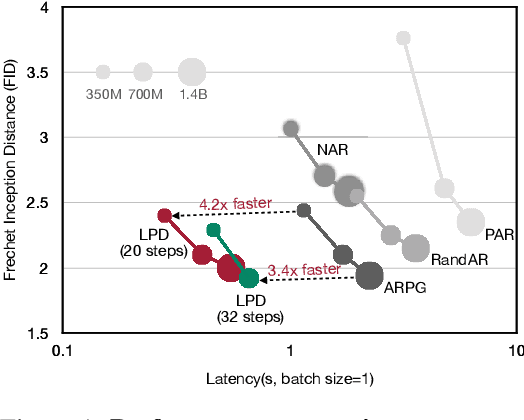
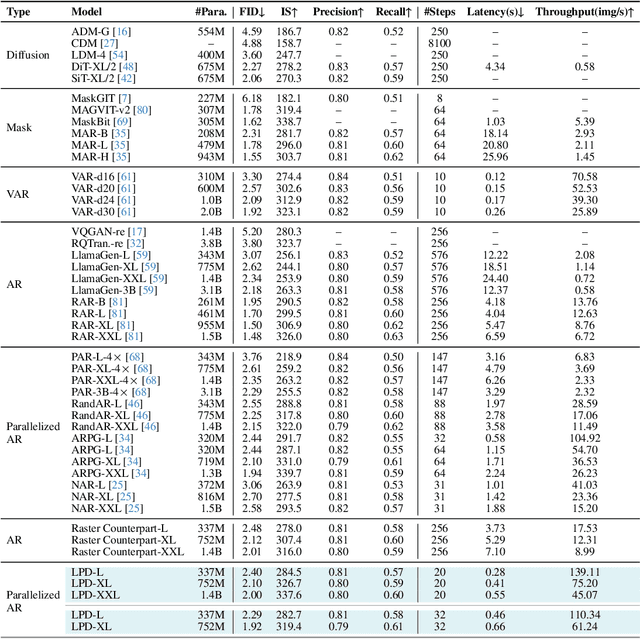
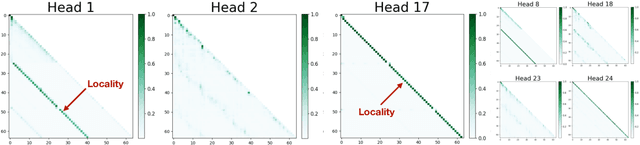
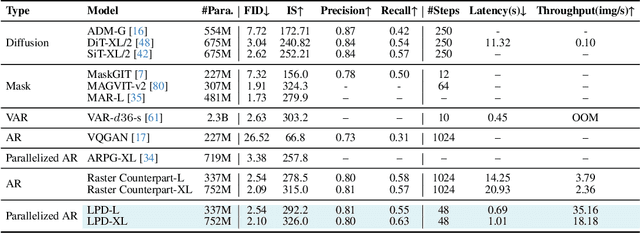
We present Locality-aware Parallel Decoding (LPD) to accelerate autoregressive image generation. Traditional autoregressive image generation relies on next-patch prediction, a memory-bound process that leads to high latency. Existing works have tried to parallelize next-patch prediction by shifting to multi-patch prediction to accelerate the process, but only achieved limited parallelization. To achieve high parallelization while maintaining generation quality, we introduce two key techniques: (1) Flexible Parallelized Autoregressive Modeling, a novel architecture that enables arbitrary generation ordering and degrees of parallelization. It uses learnable position query tokens to guide generation at target positions while ensuring mutual visibility among concurrently generated tokens for consistent parallel decoding. (2) Locality-aware Generation Ordering, a novel schedule that forms groups to minimize intra-group dependencies and maximize contextual support, enhancing generation quality. With these designs, we reduce the generation steps from 256 to 20 (256$\times$256 res.) and 1024 to 48 (512$\times$512 res.) without compromising quality on the ImageNet class-conditional generation, and achieving at least 3.4$\times$ lower latency than previous parallelized autoregressive models.
CoT-VLA: Visual Chain-of-Thought Reasoning for Vision-Language-Action Models
Mar 27, 2025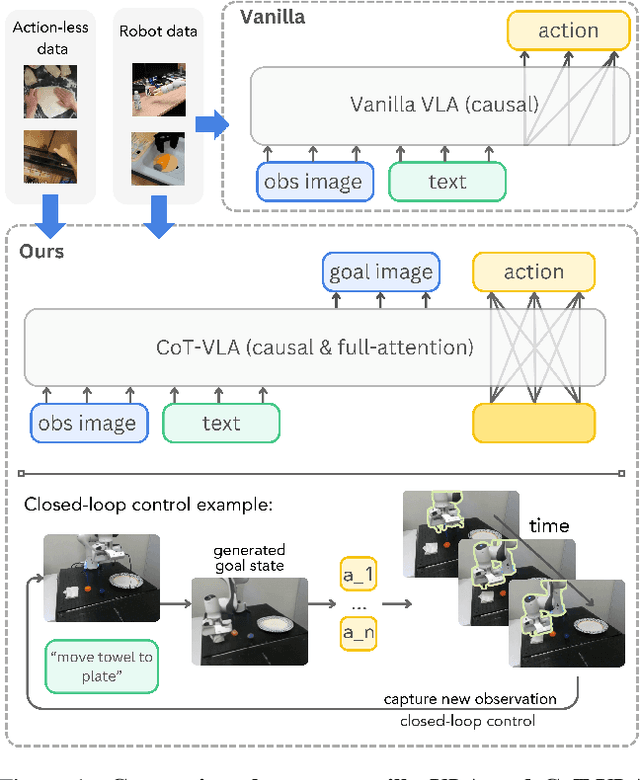

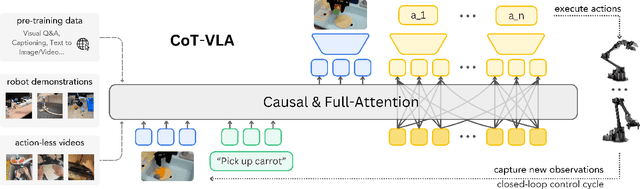
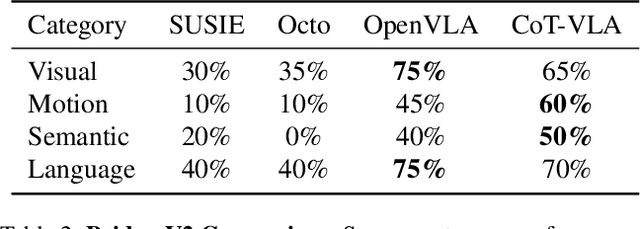
Vision-language-action models (VLAs) have shown potential in leveraging pretrained vision-language models and diverse robot demonstrations for learning generalizable sensorimotor control. While this paradigm effectively utilizes large-scale data from both robotic and non-robotic sources, current VLAs primarily focus on direct input--output mappings, lacking the intermediate reasoning steps crucial for complex manipulation tasks. As a result, existing VLAs lack temporal planning or reasoning capabilities. In this paper, we introduce a method that incorporates explicit visual chain-of-thought (CoT) reasoning into vision-language-action models (VLAs) by predicting future image frames autoregressively as visual goals before generating a short action sequence to achieve these goals. We introduce CoT-VLA, a state-of-the-art 7B VLA that can understand and generate visual and action tokens. Our experimental results demonstrate that CoT-VLA achieves strong performance, outperforming the state-of-the-art VLA model by 17% in real-world manipulation tasks and 6% in simulation benchmarks. Project website: https://cot-vla.github.io/
* Project website: https://cot-vla.github.io/
NVILA: Efficient Frontier Visual Language Models
Dec 05, 2024

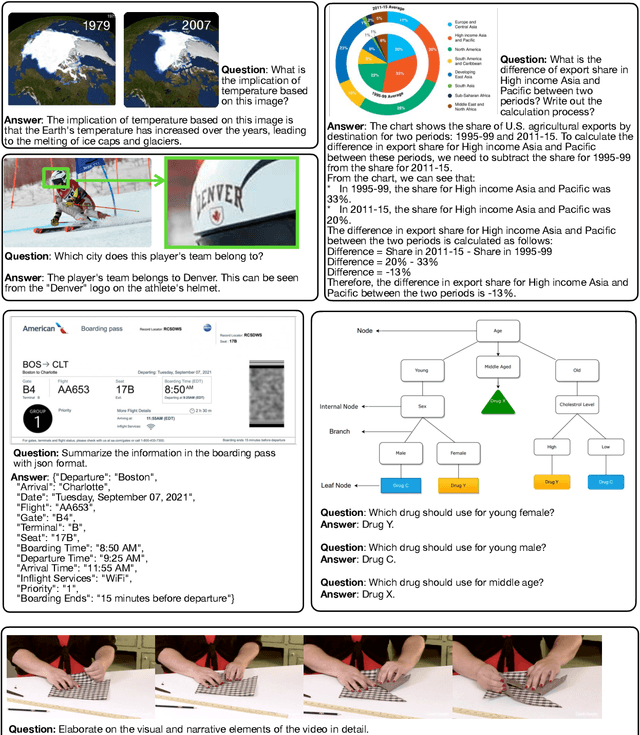

Visual language models (VLMs) have made significant advances in accuracy in recent years. However, their efficiency has received much less attention. This paper introduces NVILA, a family of open VLMs designed to optimize both efficiency and accuracy. Building on top of VILA, we improve its model architecture by first scaling up the spatial and temporal resolutions, and then compressing visual tokens. This "scale-then-compress" approach enables NVILA to efficiently process high-resolution images and long videos. We also conduct a systematic investigation to enhance the efficiency of NVILA throughout its entire lifecycle, from training and fine-tuning to deployment. NVILA matches or surpasses the accuracy of many leading open and proprietary VLMs across a wide range of image and video benchmarks. At the same time, it reduces training costs by 4.5X, fine-tuning memory usage by 3.4X, pre-filling latency by 1.6-2.2X, and decoding latency by 1.2-2.8X. We will soon make our code and models available to facilitate reproducibility.
HART: Efficient Visual Generation with Hybrid Autoregressive Transformer
Oct 14, 2024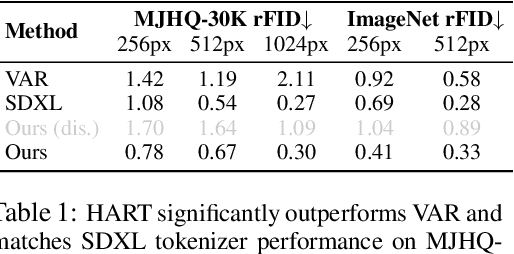


We introduce Hybrid Autoregressive Transformer (HART), an autoregressive (AR) visual generation model capable of directly generating 1024x1024 images, rivaling diffusion models in image generation quality. Existing AR models face limitations due to the poor image reconstruction quality of their discrete tokenizers and the prohibitive training costs associated with generating 1024px images. To address these challenges, we present the hybrid tokenizer, which decomposes the continuous latents from the autoencoder into two components: discrete tokens representing the big picture and continuous tokens representing the residual components that cannot be represented by the discrete tokens. The discrete component is modeled by a scalable-resolution discrete AR model, while the continuous component is learned with a lightweight residual diffusion module with only 37M parameters. Compared with the discrete-only VAR tokenizer, our hybrid approach improves reconstruction FID from 2.11 to 0.30 on MJHQ-30K, leading to a 31% generation FID improvement from 7.85 to 5.38. HART also outperforms state-of-the-art diffusion models in both FID and CLIP score, with 4.5-7.7x higher throughput and 6.9-13.4x lower MACs. Our code is open sourced at https://github.com/mit-han-lab/hart.